
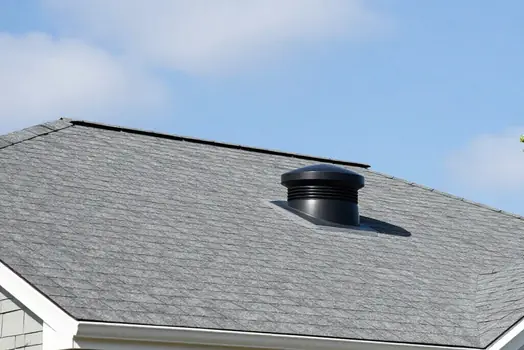
Most Vancouver Island homes breathe through passive vents, but some attics need a fan to move enough air, and a badly chosen fan can cause more trouble than it solves. The old advice of simply adding power does not hold up. This guide compares passive and active attic ventilation, explains the building code vent-area rule, covers fan controls, backdrafting risk and running costs, and shows when passive vents are enough.
Passive Versus Active Attic Ventilation
Passive ventilation uses no electricity. Cool air enters low in the attic, warm air leaves high, and wind and the stack effect do the moving. Active ventilation adds a powered fan, electric or solar, that pulls air out of the attic on a set trigger such as temperature or humidtiy.
Both approaches have the same goal: carry heat and moisture out of the space under your roof. Either one fails if the air has nowhere to come in, which is why intake comes first in every design. Trapped moisture is also what leads to mold staining on the roof deck.
| Vent type | Where it sits | Power | Main limit |
|---|---|---|---|
| Soffit vent | Under the eaves | None | Insulation can block it |
| Ridge vent | Along the roof peak | None | Needs open intake below |
| Gable vent | On the end walls | None | Moves air only near the wall |
| Electric fan | Roof or gable | Mains | Can pull indoor air |
| Solar fan | Roof, sun side | Solar panel | Runs only in daylight |
Balanced Intake and Exhaust
A ventilated attic is a loop: air in low at the soffits, air out high at a ridge, roof or gable vent. If exhaust is larger than intake, the extra air has to come from somewhere else, and the easy source is the ceiling below you.
Check the soffits first. Insulation pushed into the eaves, painted-over screens and missing baffles are the usual blockers. Our attic ventilation service starts with clearing and baffling the intake before anything gets added on the roof.
The 1:300 and 1:150 Code Rule of Thumb
Part 9 of the BC Building Code sets a minimum. In the text we checked, the unobstructed vent area must be at least 1/300 of the insulated ceiling area. It rises to 1/150 where the roof slope is less than 1 in 6 or the roof is built with roof joists. At least 25% of the required opening must be at the top of the space and at least 25% at the bottom, spread on opposite sides of the building. The code also asks for at least 63 mm of space between the top of the insulation and the roof sheathing.
For a 100 square metre insulated ceiling, 1/300 works out to about 0.33 square metres, or 3,333 square centimetres, of unobstructed vent area. At 1/150 that doubles to about 6,667. "Unobstructed" means the open area after screens and louvres, so read the net free area printed on the vent, not its face size. Code editions are updated, so confirm the current wording with your local building department before you rely on these ratios, per the BC Building Code Part 9 text.
Powered Fans: Electric, Solar and Controls
A powered fan can pull a large volume of air out of an attic. Electric models usually run from a thermostat, a humidity switch (hygrostat), or both. A thermostat starts the fan when the attic gets hot. A hygrostat starts it when the air gets damp, which suits the cool, wet shoulder seasons on the coast better than a heat-only setting.
Solar-powered fans have no wiring to the house and no operating bill. They start when the sun hits the panel and stop at dusk, so they do little during a damp winter night. Some models also take a remote or app setting, so ask what control the model you are quoted actually has.
Backdrafting and Pulling Conditioned Air
This is the main reason fans get a bad reputation. A fan exhausting the attic lowers the air pressure up there, and air moves toward the low pressure by the easiest path. That path is often through ceiling light fixtures, attic hatches and wiring holes from your heated rooms. According to Energy Vanguard, a powered attic ventilator pulls air from wherever it can, and it can backdraft a water heater, furnace or boiler and put carbon monoxide in the house.
Green Building Advisor notes that small solar units rarely pull hard enough to cause these problems, and that powered ventilators are only reasonable where there is no natural-draft combustion appliance and no air conditioning running at the same time. See the Green Building Advisor article. If you burn gas or wood, ask a qualified professional to check for backdraft risk before any electric fan goes in.
The fix that solves both problems is to air-seal the ceiling and insulate the attic properly. A sealed ceiling cannot be drawn on, and it also stops the warm, moist indoor air that causes most attic moisture.
What Running a Fan Costs
A solar fan costs nothing to run. An electric fan is easy to estimate: watts divided by 1,000, times hours of running, times your price per kilowatt hour. Ask for the wattage and the thermostat setting, then calculate it yourself from your BC Hydro bill.
The hidden cost is the air the fan draws from your living space. In summer that is air you already cooled or in winter air you already heated. Add the price of the fan and wiring, and the fan only pays off in an attic that is sealed and under-ventilated.
When Passive Ventilation Is Enough
For most coastal houses, passive vents are enough when three things are true:
- The soffits are open and baffled, so insulation does not touch the roof sheathing.
- The vent area meets the 1/300 or 1/150 ratio, split between low and high openings.
- Bathroom, kitchen and dryer exhaust goes outdoors, not into the attic.
Some building scientists go further and argue that sealing the ceiling matters more than any vent. A fan is worth discussing when the vents are correct and the attic still shows moisture or heat damage, or when the roof shape limits how many vents fit.
Get Connected With Our Insulation Experts
The right answer depends on what is actually in your attic. Attics.ca offers no-charge attic inspections where the team inspects the vents, soffits and ceiling, takes photos and explains the findings, so you can see whether a fan is worth considering.
Visit Attics.ca to see everything we do, or call (833) 422-8842 to talk with our insulation experts. We reply to calls and form requests Monday to Friday, 8:00 am to 4:30 pm, and every free inspection starts with a visit to your attic or crawl space.