
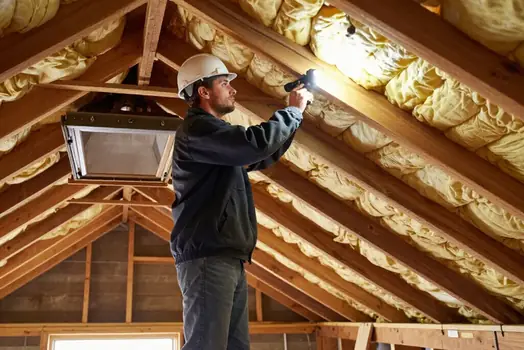
Most homeowners have rarely, if ever, been up in their own attic, so problems can sit there unnoticed for years. This guide explains what is normally in a British Columbia attic, the signs that point to a problem, what a no-charge Attics.ca inspection covers, how to read what you find, how often to check, and why an inspection matters when you buy or sell a home.
What Is Normally in a BC Attic
A healthy attic is a quiet space with a few predictable parts. Knowing them makes it easier to spot what is out of place.
| Item | What it should look like |
|---|---|
| Insulation | Even depth, dry, no low spots |
| Soffit vents and baffles | Clear channel from eave to attic |
| Bath and kitchen fan ducts | Sealed joints, ending outside |
| Wiring and light fixtures | Intact, clear of loose insulation |
| Attic hatch | Insulated, weatherstripped, latched |
| Roof sheathing and rafters | Pale, dry wood, no dark stains |
Better Homes BC says new homes in climate zone 4 (southern Vancouver Island and the Lower Mainland) need at least R40 in the attic, and it describes a well-insulated attic as R40 to R60. Older homes often have far less.
One caution: loose, pebble-like gray or gold insulation may be vermiculite sold before 1990, which can contain asbestos. Health Canada's advisory says to avoid disturbing it. Do not walk through it or move it.
Signs You Need an Inspection
- Frost or ice in the attic in winter. Natural Resources Canada says some frost is expected in cold snaps, but a heavy buildup of about 10 mm (2 in.) or more means you should check that ventilation is present and not blocked by insulation.
- High heating bills or rooms that never get comfortable.
- Ceiling stains or peeling paint, which can mean a roof leak or condensation.
- Noises such as scratching or running overhead, a sign of rodents.
- Drafts near ceiling lights, the hatch or upstairs walls.
- Musty smells or visible dark staining on the underside of the roof.
Why an Inspection Beats Going Up Yourself
Most people look to see whether the attic is dry, but that is not enough. A proper check also covers insulation depth, air leaks from the house, ventilation and duct terminations. It also carries real risks:
- Climbing a ladder and pulling yourself through a narrow hatch.
- Stepping only on framing, because a misstep goes through the ceiling.
- Nails poking through the roof sheathing at head height.
- Poor light and dust, and insulation you may not want to touch or breathe.
- Rodents that can startle you in a tight space.
What Our No-Charge Inspection Covers
Our team goes up so you do not have to. We inspect the attic, take photos and explain what we find, and you can stay off the ladder. Here is what we look at:
- Attic insulation level, condition and whether it should be improved.
- Signs of rodents and other pests.
- Attic ventilation, since poor airflow leads to moisture and mold.
- Bathroom, dryer and kitchen duct seams and terminations, where old tape often fails and leaks moisture into the attic.
- Mold staining, which is a sign that moisture and air movement are out of balance.
- Roof leaks coming through into the attic.
- Your attic hatch: design, seal and insulation.
- Earlier handyman work that was not finished properly, and structural problems.
We also provide the same no-charge inspection for a crawl space. If work is needed, we give you a quote, and we can guide you through government rebates.
How to Read Your Own Findings
If you do look into your attic from the hatch, use the photos or what you see to compare against this table.
| What you see | Likely meaning | Next step |
|---|---|---|
| Insulation level with or below the joist tops | Likely under R40 | Measure depth, consider adding |
| Discolored insulation | Air leaking from the house | Natural Resources Canada calls this a tell-tale sign of leakage |
| Dark stains on wood | Moisture over time | Find the source first |
| Crushed or disconnected duct | Moist air entering attic | Reconnect and seal |
| Droppings or chewed material | Rodent entry | Ask a professional |
Better Homes BC suggests getting a knowledgeable professional's advice if insulation is uneven, has low spots, contains moisture, or shows rodent pathways. Natural Resources Canada also notes that exhaust fans should discharge outdoors, not directly below an eave vent, and that wet insulation should not be covered until the moisture source is removed and the insulation is dry. The same Keeping the Heat In guide explains these checks in more depth.
What to Do With What You Find
Work from the cheapest fix to the biggest, and fix moisture soucres before you add insulation. Natural Resources Canada says wet insulation should not be covered until the source of moisture is removed and the insulation is dry.
- Reconnect and seal ducts. Seal duct joints with aluminum duct tape or mastic, and make sure exhaust fans discharge outside.
- Seal the hatch. Caulk around the frame, weatherstrip the edges, add a latch that holds it against the weatherstripping, and insulate the hatch itself. A ready-made attic hatch cover is another option.
- Seal air leaks around wiring, plumbing stacks and ceiling fixtures before adding insulation.
- Clear ventilation paths that insulation has blocked.
- Add or replace insulation once the attic is dry. Insulation damaged by mold or vermin should be removed (but never vermiculite, which needs testing first).
Ask a professional before making any decision that involves electrical fixtures or possible asbestos.
How Often to Check and When to Buy or Sell
A look at least once a year is a sensible habit, and the best times are during or just after a cold snap or a heavy rain, when Natural Resources Canada says frost and moisture sources show up. Check again after a roofing job, a renovation or a windstorm.
An inspection also helps when you buy or sell. A buyer can learn insulation level, moisture history and the state of the hatch and ducts before closing, and a seller can fix small issues and show photos instead of leaving questions open. Ask a professional if you need advice on how findings affect a sale or an insurance claim.
Get Connected With Our Insulation Experts
Our team has years of experience in insulation and home construction, and a no-charge attic insulation inspection is a simple way to learn what is in your attic without risking a fall. We inspect, photograph and explain, and you decide what, if anything, to do next.
Visit Attics.ca to see everything we do, or call (833) 422-8842 to talk with our insulation experts. We reply to calls and form requests Monday to Friday, 8:00 am to 4:30 pm, and every free inspection starts with a visit to your attic or crawl space.