
Black staining on attic wood is common on Vancouver Island, and it nearly always points to a moisture problem, not just a cleaning job. Mold usually grows in fall and winter, not summer, because heated indoor air escapes into a cold attic. This guide covers what causes attic mold, how to tell it from dirt and wood stain, what Health Canada says about health, when to call a professional, and the order of repairs that keeps it from returning.
Why Mold Grows in the Attic
Mold needs moisture, a food source and time. Attic sheathing and framing are wood, so the food is always there. Moisture is the part you can control. Health Canada says mold will begin to grow within 48 hours where there is too much moisture. Mold that comes back after cleaning usually means the moisture source was never fixed.
People expect mold in summer humidity. On the coast it is more likely from October to March. Warm, damp air from the living space rises into a cold attic, meets the cold roof deck and condenses.
Common Causes of Attic Mold
- Warm moist air leaking up through light fixtures, wiring holes, wall tops and a poorly sealed attic hatch.
- Bath, kitchen or dryer ducts that end in the attic, or are loose or unsealed at the joints.
- Blocked soffits, where insulation covers the intake so fresh air cannot enter.
- Missing baffles or rafter chutes, especially after insulation was added.
- Too little exhaust venting at the ridge or roof for the size of the attic.
- Thin insulation, which lets more heat and moisture pass into the space.
Most of these are fixable. Several can appear together, which is why the staining often shows over one part of the roof first, usually near a leak or a duct.
Mold, Dirt or Wood Stain?
Not every dark mark is mold. A quick look and touch helps you decide whether to call someone.
| Looks like | Feels like | More likely |
|---|---|---|
| Black or green spots, fuzzy or speckled | Raised, damp, musty smell | Active mold |
| Flat dark patch with a ring edge | Smooth, dry | Old water stain |
| Grey, even film on top of wood | Wipes off dry | Dust and soot |
| Uniform brown or tan streaks | Flat, no smell | Natural wood stain |
A moisture meter reading on the sheathing helps: dry wood under a stain suggests old, dormant growth, while wet wood suggests the problem is still going. Visual checks are only a guide. Health Canada does not recommend testing the air for mold, so the moisture reading and the look of the wood tell you more than lab reuslts.
Health Considerations From Health Canada
According to Health Canada, living with mold and damp conditions is linked to eye, nose and throat irritation, coughing, wheezing and shortness of breath, and worse asthma. Infants, children, seniors, pregnant people and those with respiratory conditions are most at risk. An attic is not a living space, but air moves between the two, so keep the attic hatch closed and sealed.
We are not medical professionals. If someone in your home has symptoms or asthma, speak to your doctor or public health unit.
When to Call a Professional for Attic Mold Removal
Health Canada's size guide is practical. One square metre of mold or less counts as a small area a homeowner can clean. More than three patches, each smaller than one square metre, counts as medium, and in most cases it can still be cleaned with proper procedures and protective gear. A single patch larger than three square metres is a large area and needs a qualified professional. Call one as well if the mold comes back after cleaning.
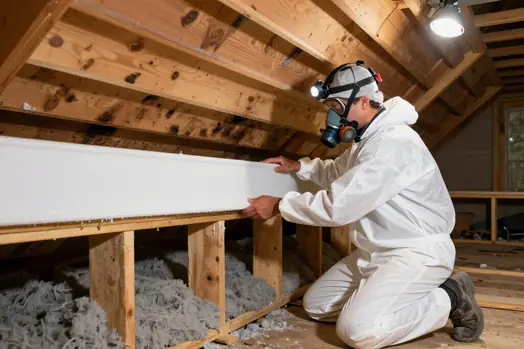
Attics add their own risks: tight spaces, ceiling joists you can step through, poor light and insulation dust. Wear safety glasses, a well-fitting N95 respirator and gloves if you go up at all. Our team can inspect for you and photograph what we find, so you can stay in the house.
Homeowners often ask about the cost of attic mold removal before anyone has looked. The price depends on what the inspection finds: how much of the roof deck is stained, how easy the attic is to reach, whether wet or moldy insulation has to come out, and which moisture and ventilation repairs are needed so the mold does not return. That is why every job starts with a free attic inspection with photos, and the quote follows from what we find.
Our crews travel from Nanaimo for attic mold cleanup in Ladysmith, Duncan, Victoria, Sidney and the towns between. Looking for attic mold remediation near you? Book a free inspection and we will explain what the job involves before any work starts.
The Fix Order: Moisture First
Cleaning first and fixing later wastes the money, because mold regrows on clean wood in a damp attic. Work in this order:
- Stop the moisture source. Redirect any duct that ends in the attic to the outdoors, seal ceiling leaks and the hatch, and repair roof leaks.
- Clean or treat the stains. Health Canada says not to use bleach to clean up mold. Heavier staining is handled by mold stain removal, and our guide to attic mold removal walks through the cleanup itself. Damp insulation is removed and replaced, see insulation removal.
- Upgrade ventilation and insulation. Attic ventilation upgrades start at the soffits: clear them, add baffles, check vent area against the 1/300 or 1/150 rule in the BC Building Code, then add insulation to the depth your climate zone calls for.
Where the vents are correct and moisture continues, an active attic ventilation fan may be worth a conversation. It is the last step, not the first.
Preventing Mold From Coming Back
- Run bathroom fans during and for at least 30 minutes after showers.
- Keep indoor humidity between 30 and 50 percent.
- Check the attic each fall before the damp season.
- Keep the soffits clear when anyone adds insulation.
- Look at the roof deck after storms for new leaks.
A free attic inspection with Attics.ca shows you where the moisture is getting in, with photos, a written explanation and recommendations on stain removal and ventilation. We can also guide you through the government rebates available for insulation upgrades.
Get Connected With Our Insulation Experts
Visit Attics.ca to see everything we do, or call (833) 422-8842 to talk with our insulation experts. We reply to calls and form requests Monday to Friday, 8:00 am to 4:30 pm, and every free inspection starts with a visit to your attic or crawl space.